AEGIS at a glance
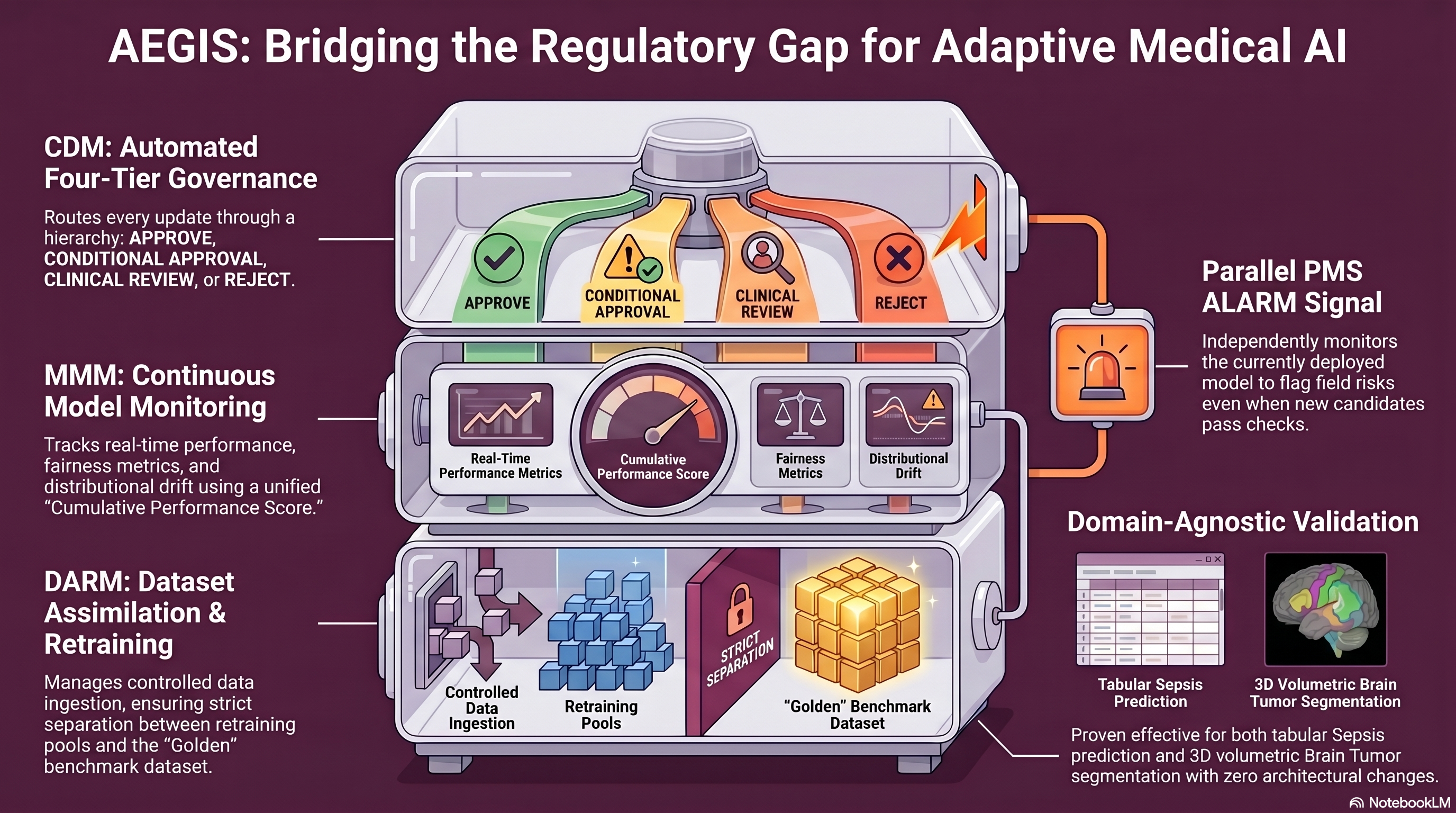
A visual summary of the framework: data management, monitoring, and structured decision-making under FDA and EU regulatory frameworks.
An Operational Infrastructure for Post-Market Governance of Adaptive Medical AI Under US and EU Regulatory Frameworks
A visual summary of the framework: data management, monitoring, and structured decision-making under FDA and EU regulatory frameworks.
A quick introduction to the AEGIS framework and its research foundation.
A concise conversational introduction to the AEGIS framework covering the three-module architecture and key decision categories.
A detailed discussion of the AEGIS infrastructure, including threshold derivation, regulatory mapping, validation results, and implementation guidance.
A 10-minute walkthrough of the AEGIS three-module architecture and regulatory decision logic.
↗ Watch on YouTubeA detailed presentation of the AEGIS infrastructure, validation results, and regulatory alignment.
↗ Watch on YouTubeMedical AI systems that learn from new data need structured post-market oversight — not just initial approval.
DARM manages data, MMM monitors performance and drift, CDM makes structured decisions.
Dataset Assimilation and Retraining Module. Manages training (DT,k), golden (DG), and drifting (DD,k) datasets with unconditional accumulation.
Model Monitoring Metrics. Computes MLcps composite score, drift detection via Bonferroni-corrected KS test, and fairness metrics.
Clinical Decision Module. Priority-ordered decision hierarchy (P1–P4) with independent PMS alarm channel (A1–A3).
Four deployment decision categories with composite output — APPROVE + ALARM is not contradictory.
| Priority | Condition | Decision | Regulatory action |
|---|---|---|---|
| P1 (highest) | Any metric < Pfail | REJECT | Suspend model; initiate CAPA |
| P2 | Performance buffer / regression from Pref | CLINICAL REVIEW | Hold deployment; clinician review required |
| P3 | Minor drift or TAI concern | CONDITIONAL APPROVAL | Deploy with enhanced monitoring |
| P4 (lowest) | All checks pass | APPROVE | Release model; routine PMS |
Three paths to implementing AEGIS in your organisation.
9 chapters covering concepts, configuration, thresholds, CDM logic, drift detection, audit trail, and regulatory mapping.
Start reading →Interactive forms with pre-fill examples (sepsis, brain tumour). Download completed documents as .docx — all data stays in your browser.
Open forms →Jupyter notebook with 11 iterations of adaptive AI governance on the PhysioNet Sepsis Challenge dataset. All four deployment decision categories exercised.
View examples →Performance trajectories across iterative governance cycles.
Two complete case studies demonstrating AEGIS across different clinical domains.
PhysioNet Challenge 2019. Random Forest classifier. 11 iterations with progressive data corruption. All four deployment decision categories exercised.
BraTS 2023/24. nnU-Net ResENC-M. 12 iterations with binary APPROVE/REJECT governance (intermediate categories disabled).
If you use AEGIS in your research, please cite our preprint:
@article{afdideh2026aegis,
  title   = {AEGIS: An Operational Infrastructure for Post-Market
             Governance of Adaptive Medical AI Under US and EU
             Regulatory Frameworks},
  author  = {Afdideh, Fardin and Astaraki, Mehdi and Seoane, Fernando
             and Abtahi, Farhad},
  year    = {2026},
  journal = {Research Square (Preprint)},
  doi     = {10.21203/rs.3.rs-9199100/v1},
  url     = {https://doi.org/10.21203/rs.3.rs-9199100/v1}
}